
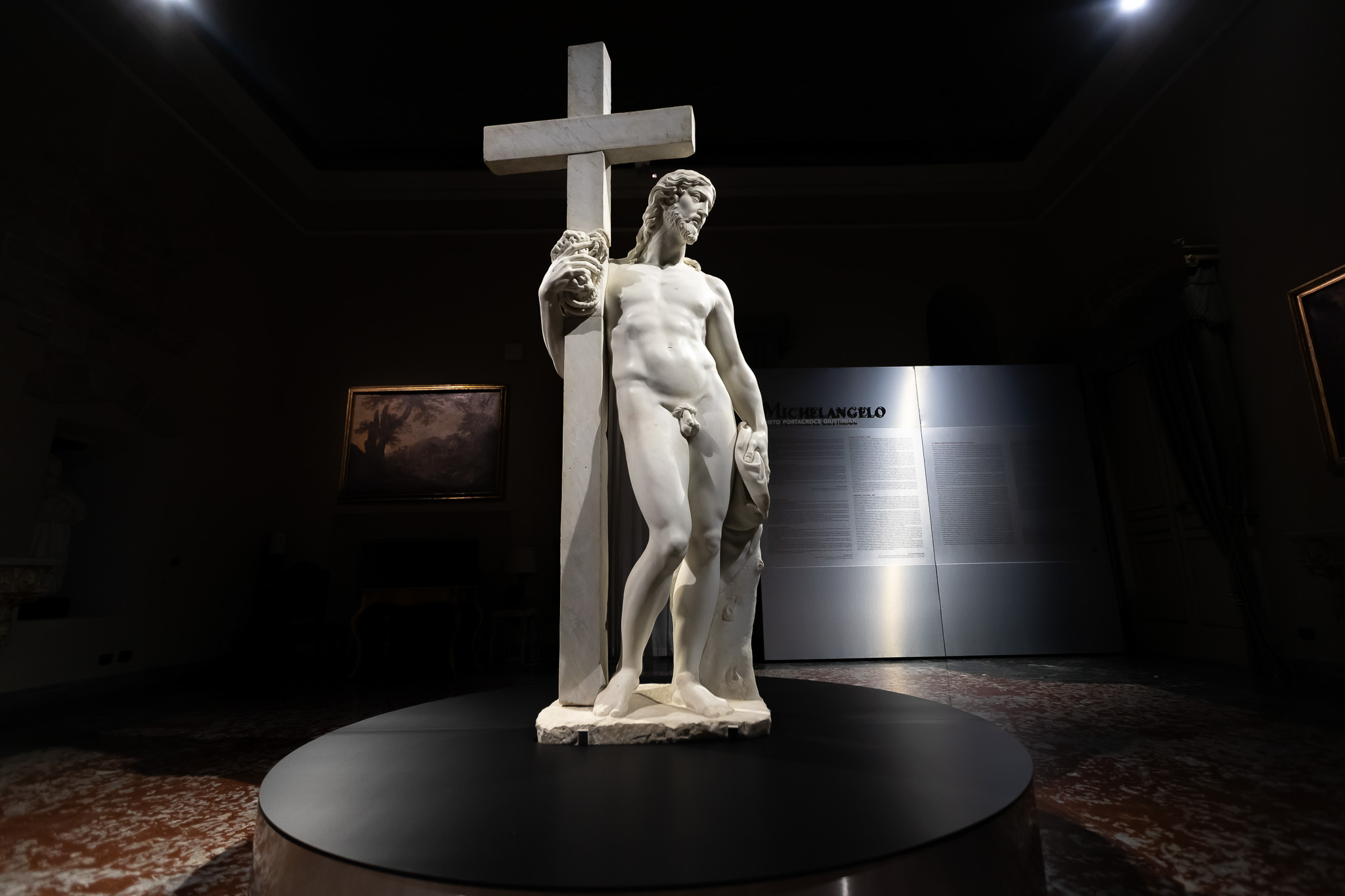

FROM OSAKA TO SICILY: THE FEDERICO II FOUNDATION BRINGS TO THE ISLAND THE RISEN CHRIST WITH THE CROSS – GIUSTINIANI.
ON DISPLAY UNTIL APRIL 30.
A MICHELANGELO AT PALAZZO REALE IN PALERMO
The black “vein” on the face, poorly tolerated by the “Divine”, has over time made the work even more famous. The most accredited theory claims that Bernini was the one who completed it.
The exhibition is conceived, organized, and curated by the Federico II Foundation, in collaboration with the Sicilian Regional Assembly, the Monastery of San Vincenzo Martire – Silvestrine Benedictine Monks, the Ministry for the Protection of Cultural Heritage (DIT Directorate General for Archaeology, Fine Arts and Landscape, Service IV Circulation), and the Superintendence of Archaeology, Fine Arts and Landscape for the Province of Viterbo and Southern Etruria.
Palermo. That black “vein” on the face, a natural defect in the marble, appeared to Michelangelo as a serious imperfection—so much so that he decided not to complete the work. Today, however, it is considered one of the masterpieces of Renaissance sculpture and represents an important example of the art of the “Divine.” Michelangelo’s Christ is Neoplatonic—radiant, aesthetically sublime, illuminating and healing every wound and sorrow of humanity.
The Federico II Foundation has presented today at Palazzo Reale in Palermo the Risen Christ with the Cross – Giustiniani. Exhibited in the Royal Apartments of the Palace, it will be open to the public from November 13, 2025, to April 30, 2026.
Its history and attribution have always generated great interest among scholars. That imperfection perhaps brings Christ closer to our own suffering and human frailty. A work that powerfully and effectively connects to contemporary life.
The exhibition is conceived, organized, and curated by the Federico II Foundation, in collaboration with the Sicilian Regional Assembly, the Monastery of San Vincenzo Martire – Silvestrine Benedictine Monks, the Ministry for the Protection of Cultural Heritage (DIT Directorate General for Archaeology, Fine Arts and Landscape, Service IV Circulation), and the Superintendence of Archaeology, Fine Arts and Landscape for the Province of Viterbo and Southern Etruria.
The Risen Christ fits within the artistic and cultural context of the Italian Renaissance, a period of fervent creativity and spiritual renewal—a thread that connects the work to the magnificent Palazzo Reale of Palermo, whose Renaissance traits are exemplified by the Maqueda Courtyard, with its arches and loggias.
“Sicily welcomes this masterpiece by Michelangelo,” said Gaetano Galvagno, President of the Federico II Foundation, “with a work that represents Renaissance sculpture at its finest. At the same time, the Risen Christ perfectly embodies the deep connection between Italian cultural history and universal spirituality. The milestone achieved today by the Federico II Foundation marks a historic moment and makes us grateful to all who contributed to reaching it. We are confident that this exhibition will further boost the tourism growth that has already brought a significant increase in visitors to Palazzo Reale over the past year.”
The Risen Christ with the Cross – Giustiniani is an imposing Carrara marble sculpture depicting Jesus Christ after the Resurrection. It was attributed to Michelangelo Buonarroti only in 2001, thanks to the meticulous studies of Silvia Danesi Squarzina and her then student Irene Baldriga, who dispelled any remaining doubts. The statue is now recognized as the first version of another Christ, the one commissioned by Metello Vari for the church of Santa Maria sopra Minerva in Rome.
“For a long time,” explains art historian Pierluigi Carofano, “it was thought to be the work of an anonymous yet skilled 17th-century sculptor—a free interpretation inspired by the famous Redeemer Christ created by Michelangelo between 1519 and 1521 for the Dominican church of Santa Maria sopra Minerva in Rome, commissioned by Metello Vari on behalf of the Porcari family heirs. It is, instead, a highly important work by Michelangelo, not only for the originality of its composition—considering such a delicate subject at a time when the first winds of the Lutheran Reformation were blowing—but also for the unique events the sculpture experienced over time.”
The Risen Christ with the Cross – Giustiniani holds a cross and bears on its face a dark vein. That black vein, a natural flaw in the marble, appeared to Michelangelo as a severe imperfection and led him to abandon the work, later trading it for a foal to the same Vari, who placed it in the garden of his residence in Rome.
Over the following years, all documentation of the statue was lost until 1607, when letters confirmed its presence on the art market. In 1638, Marquis Vincenzo Giustiniani purchased the unfinished marble, which—according to the most credited theory—was completed by a trusted sculptor, likely the young Gian Lorenzo Bernini. The intervention of Bernini results in the coexistence of the genius of the two greatest sculptors of all time—one of the Renaissance, the other of the Baroque.
“It is with great pride,” says Antonella Razete, Director General of the Federico II Foundation, “that the Foundation offers visitors the opportunity to admire an absolute masterpiece of Renaissance sculpture, the Risen Christ with the Cross – Giustiniani. Having one of Michelangelo’s most significant sculptural works within the Royal Apartments is a multiplier of beauty for Palazzo Reale. Its presence is in perfect harmony with the setting—no place could be more fitting. Here, in the magnificence of the Palatine Chapel, the divine constantly dialogues with art.”
The Christ is a witness to beauty, requested worldwide—from Germany to the United Kingdom, from Mexico to Japan. In Palermo, it arrives directly from Osaka. Its official and permanent home is in Italy: the Chapel of the Christ with the Cross in the Sanctuary of the Holy Face in Bassano Romano, Province of Viterbo.
“Through a donation made shortly after World War II,” explains Duverly Berckus Goma, Prior of the Monastery of San Vincenzo Bassano, “the Silvestrine Benedictine Congregation received a five-hectare plot in Bassano Romano, on a hill where an abandoned church stood. When the monks began restoring it, they discovered, hidden under a tangle of brambles, a marble statue of a nude Christ placed on a niche above the main altar. The brambles had concealed it for centuries. Later, documents from the archives of Palazzo Giustiniani in Rome—including the inventory of Vincenzo Giustiniani’s art collection—suggested its attribution to Michelangelo, which became certain in the early 2000s, when a cleaning intervention revealed the black vein on the statue’s face, matching the one described by Ulisse Aldrovandi in 1556.”
This was indeed the Risen Christ with the Cross, sculpted by Michelangelo between 1514 and 1516, prior to the version still preserved in Santa Maria sopra Minerva in Rome.
“The foresight of the Federico II Foundation and teamwork with numerous partners,” notes Gabriele Accornero, Advisor to the Foundation, “have made it possible to bring this highly valuable work to Sicily for the first time, in a unique setting like Palazzo Reale, with a dedicated exhibition design. The attribution of the work to Michelangelo is largely due to Irene Baldriga, who, through cross-referencing stylistic, material, and documentary evidence, connected it to a 1521 letter from Metello Vari to Michelangelo, in which the sculptor’s decision to abandon the work of a marble block is mentioned. The letter leaves no doubt in identifying the statue as the first version of the Risen Christ commissioned to Michelangelo in 1514.”
The visitor experience is enhanced by a custom-designed exhibition layout, respectful of the context of the Royal Apartments, as well as by a light design project by ERCO, world leader in museum lighting for major art institutions.
The exhibition is open until April 30, 2026, from Thursday to Monday.
Info and details: https://www.federicosecondo.org/costo-biglietto/
THE RISEN CHRIST AROUND THE WORLD:
Since its definitive attribution to Michelangelo Buonarroti, the work has been exhibited in several international exhibitions, including:
-
Berlin, Alte Nationalgalerie, Caravaggio in Preussen: Die Sammlung Giustiniani und die Berliner Gemäldegalerie, 2001
-
Mexico City, Palacio de Bellas Artes, Miguel Ángel Buonarroti: un artista entre dos mundos, 2015
-
London, National Gallery, Michelangelo & Sebastiano: The Credit Suisse Exhibition, 2017
-
Tokyo, Mitsubishi Ichigokan Museum, Leonardo da Vinci e Michelangelo, 2017
-
Gifu (Japan), Gifu City Museum of History, Leonardo da Vinci e Michelangelo, 2017
-
Nanjing, Nanjing Museum, Renaissance Masters: The Art of Leonardo da Vinci, Michelangelo and Raffaello, 2018
-
and finally Osaka, Expo, Italy Pavilion, 2025
Press Office
Federico II Foundation


